Introduced in early 2007 as a concept vehicle, the Chevrolet Volt has made it to production as a 2011 model. Four years is not a lot of time for automakers to develop and produce a new model, but the Volt seemed to take forever because of the hype around this innovative new car. But does the 2011 Chevrolet Volt meet expectations? It certainly does not look like the concept car shown at the 2007 Detroit auto show. But that car did not offer the practical interior dimensions of the production Volt.
The good: The weight of its battery gives the 2011 Chevrolet Volt a planted feel, and its electric power train can greatly reduce gasoline usage. The hard-drive-based navigation system warns of traffic problems. A smartphone app lets you set charging times and offers other features, such as car location.
The bad: The Volt brakes unevenly, which can lead to panic stops. The cabin interface buttons are strewn around the center stack with no apparent logic, and the navigation system does not list electric car charging stations.
The bottom line: Although pricey, the 2011 Chevrolet Volt will work excellently for anyone who commutes less than 40 miles, as it requires almost no gas during a typical week while providing a comfortable ride.
And despite Chevrolet's initial claims that the Volt's wheels would only be driven by its electric motor, Motor Trend published details showing that, under certain conditions, the Volt's gas motor supplies motive power to the wheels.
Chevrolet calls the Volt an extended-range electric vehicle, but technically it is still a hybrid, as it has both an electric motor and a gas engine to power the wheels. It is, however, a very different hybrid from the Toyota Prius. In fact, it feels light years ahead of that car, which became indelibly associated with the term hybrid.
The Volt that finally reached production looks mild-mannered, like one of the many thousands of suburban sedans rolling down the roads every day. On the streets of San Francisco, the 2011 Volt nabbed barely a look from passersby.
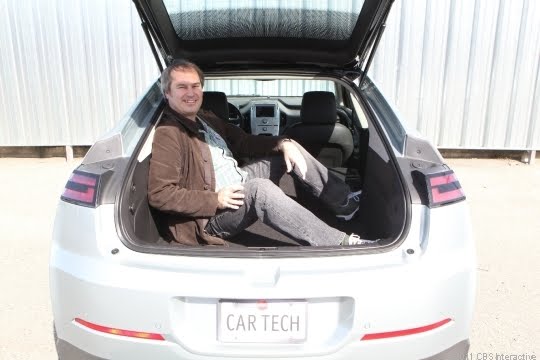
 Although its profile says sedan, the Volt is really a hatchback, with a large cargo area.
The largely closed-off grille gives some clue to the car's nature, favoring aerodynamics over air intake. The rear of the car also separates itself from a typical sedan, because the Volt is actually a hatchback. The rear lip sits just higher than that of a sedan, and a big rear hatch opens to show a spacious cargo area.
Chevrolet chose to put two bucket seats in the rear, limiting the Volt to four passengers. This arrangement, which somewhat limits the car's practicality, is because of the T-shaped 16 kWh lithium ion battery pack running down the center. But fold down the rear seats, and you can pack a lot of gear into the back of the Volt.
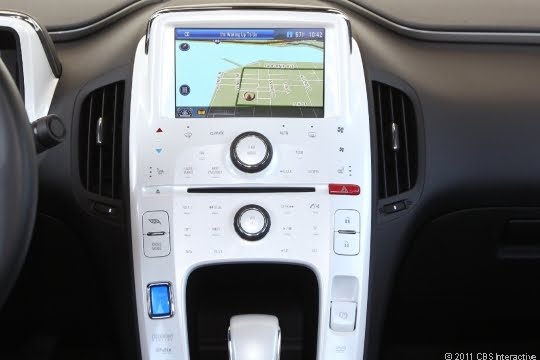
Unconventional dashboardThe dashboard, unlike on current Chevrolet models, echoes the futuristic power train of the Volt. It still has a steering wheel and pedals for acceleration and braking, but the shifter is a big white lever that nestles into the dashboard when in Park.
Above the shifter is a set of touch buttons with labels that get backlit at night. These solid-state buttons work well, showing good response and tactile behavior. But they are not logically laid out, strewn as they are across the center stack. The navigation button is on the lower left, the phone button about midway up on the right, and audio source buttons up on the left. This layout is about the only fault with this interface.
 Touch buttons on the stack work well, responding quickly and accurately.
At the top of the stack sits an LCD touch screen with good resolution. Although a knob in the center of the stack makes it convenient to scroll through list displays on the screen, it is quicker to use the touch screen for the onscreen keyboard. A voice command system also offers some basic control over the audio system, along with phone dialing and destination entry.
The Volt's navigation system makes use of the car's hard drive for map storage. It shows maps in 2D and 3D views, the latter showing select landmark buildings rendered in 3D. The map quality looks excellent, with easily readable street names and route guidance graphics.
Traffic data appears on the map as incidents and flow information. The system warns of traffic jams ahead, bringing up a screen showing the incident and an Avoid button, which recalculates the route. The system even proactively warns of trouble ahead when you haven't programmed in a destination.
The navigation system offers the usual points-of-interest database, but it doesn't offer much help in finding places to recharge the car's batteries. Strangely, the database shows not only gas stations, but locations for diesel, biodiesel, natural gas, and even hydrogen. Locations for quick charges would be convenient, even if there are not that many available yet.
 The Volt's nav system shows every kind of fuel except electricity.
 Chevrolet keeps 30GB of the Volt's hard drive reserved for music storage. The single CD/DVD player can rip music to the drive, with a Gracenote database automatically tagging all songs appropriately. The Volt also has a standard USB port, which works with an iPod cable to play music over the stereo. Both the hard drive and iPod interface make it easy to find music by the usual artist and album categories. The satellite radio interface works better than most, showing not only each channel name, but also the current song playing on each.
As a means of limiting onboard electricity use, Chevrolet uses a Bose audio system designed for efficiency. Although it doesn't boast hundreds of watts, the sound coming out of the seven-speaker system comes through with reasonable detail, the subwoofer adding some richness. It is not audiophile-quality, but it sounds better than typical six-speaker systems.
Along with the Volt's robust Bluetooth phone system, Chevrolet includes an OnStar application designed specifically for the Volt. The app can remotely unlock the doors, show the car's location, and initiate charging if the car is plugged in. This last function helps when taking advantage of non-peak electricity rates.
Range helpersAs another means of getting the most electric range from the car, the climate control screen offers an Eco mode, useful for moderately hot or cold days. Seat heaters, part of the Premium package, make it possible to drive the car without cranking the vent heat. Hypermilers in warm climates will want to rely on the Fan Only mode during most of their driving, as the air conditioning causes a hefty drain on the battery.
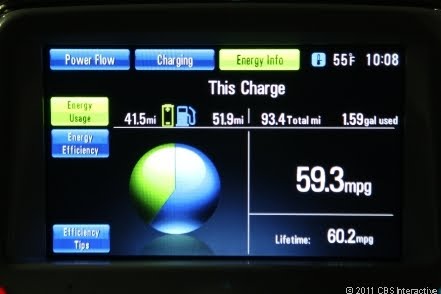
 This energy display on the center LCD shows energy efficiency and the car's lifetime fuel economy.
Energy displays on the digital instrument cluster and the main LCD help drivers get the most electric range out of the vehicle. The cluster shows remaining electric range, then switches over to a fuel level and gasoline range display when the battery is exhausted. A gauge on the right shows braking and acceleration, which in the Volt is equivalent to power regeneration and consumption.
Although hypermilers will enjoy watching the gauge to limit hard acceleration and maximize regeneration, you don't have to exhibit any particular care when driving the car. It responds the same to the accelerator whether it is operating in battery or gasoline mode. When the engine is on, it causes a slight vibration and noise, which is only really noticeable at low speeds. Electric operation is, of course, smooth and quiet.
Chevrolet makes operation of the Volt probably a little too complicated, as the shifter has Drive and Low modes, and another button cycles the power train operation through Normal, Sport, and Mountain modes. The Volt's early adopters will revel in finding the most efficient mode, but most people won't want to bother figuring out when to pull the shifter down to Low, or push the button for Mountain or Sport.
Sport delivers a more satisfying response from the accelerator, as the car moves sluggishly in Normal mode. But the difference comes down to acceleration tuning; push the accelerator hard in Normal and the Volt easily pulls out ahead of traffic. In any mode, the Volt feels heavy, due to the fact it weighs 3,781 pounds.
 The simple-looking shifter includes a Low setting, which maximizes regeneration, slowing the car drastically whenever you lift off the accelerator.
The electric drive system shows its virtues in heavy traffic, as the Volt easily creeps forward at slow speeds. At every stop light and instance of stalled traffic, it will only burn electricity associated with the climate control and accessories, limiting range loss, as opposed to gasoline-engine cars that still burn gas while idling. Even when the Volt's battery is exhausted, the engine can shut down at traffic stops.
At moderate and freeway speeds, the Volt drives comfortably, effortlessly keeping up with traffic and its suspension smoothing over rough asphalt. Road noise is audible even when the car is operating in pure battery mode, the interior sound levels being similar to those of most midsize sedans. The Volt's weight makes it generally feel more planted than similarly sized cars, and should make it less susceptible to wind buffeting.
With a full charge, the car will show a range of about 35 miles. Driving up hills or giving it heavy acceleration reduces that range quickly, but going downhill quickly adds range. When the battery runs out, the display shows a range of about 350 miles with a full gas tank. That range fluctuates with driving style as well, but the greater range masks the changes.
No average fuel economyFuel economy for the Volt is a difficult topic. The EPA says it gets 37 mpg when the gas engine is running, and 93 mpg gasoline equivalent when operating in electric mode. After driving the car through three quarters of a tank and two and a half charges, we found our car showed a total average of 61.8 mpg.
 When the Volt is running off its battery pack, the instrument cluster shows electric range.
But that number is essentially meaningless, as the fuel economy will differ drastically based on how the Volt is driven. Charge it up every night and only use a couple of gallons of gas a week, and the fuel economy display could rise above 100 mpg. Take it on a road trip and rely on the gas engine to work as a generator, and the fuel economy will drop closer to 37 mpg.
Charging from a 220-volt outlet takes about 4 hours, and from a 110-volt outlet about 12 hours, according to Chevrolet. The charge port, a standard J1772 electric vehicle plug, sits on the driver-side front fender. The gas tank only has a 9.3-gallon capacity, showing that Chevrolet did not intend the Volt to be a road trip car.
The gas engine is a small, 1.4-liter four-cylinder. Because it does not directly drive the wheels but usually only acts as a generator, it runs at a few set speeds, allowing for optimal fuel efficiency. Normal gasoline engines run through a wide range of speeds, leading to less efficiency and more wear and tear.
The Volt relies on regenerative braking to help keep the battery charged, but it leads to uneven stopping behavior. The brakes initially come on lightly, as the regenerative operation takes over. Mechanical braking doesn't take over until you've pushed the pedal down hard, at which stage it gets grabby. Using Low mode with the shifter puts the car into a heavy regenerative mode, so that it slows drastically when the accelerator lifts.
When the engine is on, switching the power train to Mountain mode causes the engine to run at a higher speed, making it more audible. Even when not in Mountain mode, the engine will switch to a higher speed if needed, such as when climbing hills. When running off the battery, switching it to Mountain mode merely seems to reduce the range on the display.
 When the gas engine is working as a generator, the instrument cluster shows the gas tank level and range.
Although the Volt offers a Sport mode, it is as much of a sports car as a Camry. It uses an electric-power-steering rig with ZF components, high-quality equipment. At low speeds, the steering feels well-powered, making it easy to turn the wheels, whereas at greater speeds, the power assist is reduced, allowing good road feel.
The low-set battery pack gives the Volt very interesting handling characteristics, so that the car never feels tippy. Hitting a corner at speed, the car is more likely to four-wheel-drift than sway excessively.
CNET editor Antuan Goodwin had the opportunity to take the Volt out on the track, and had this to say about the handling: "While the sedan didn't get out of sorts during our laps around Laguna Seca, it didn't exactly thrill, either. Understeer, that old friend of the safe and predictable production car, was present in a major way, which is to be expected. Also present was a bit of body roll, although not in the quantities that we expected, thanks to the Volt's T-shaped battery pack lowering the vehicle's center of gravity."
In sumChevrolet did an excellent job with the Volt's power train, mixing substantial electric-mode range with a gas engine, leading to potentially outstanding fuel economy. Although the different drive modes seem a little complicated, the car's normal drive feel is even better than many gas engine cars. The power steering is well-tuned, and the battery helps the handling. The uneven braking is the main problem area for performance tech.
With standard navigation, Bluetooth phone, and a Bose stereo, the cabin of the Volt features first-rate electronics. The associated smartphone app offers good connectivity and remote operation. The only area where the Volt is lacking is in driver assistance features. Its rearview camera is excellent, but it doesn't offer adaptive cruise control or a blind-spot detection system.
Chevrolet put a few nice exterior design elements into the Volt, but seems to be attempting to make the car not stand out. Its front end looks particularly conventional. The hatchback is a practical design feature, but the lack of a rear bench seat limits passenger room. The touch buttons on the interface are a neat innovation and the onscreen menus look nice, but Chevrolet could have put some more thought into a logical arrangement.
Tech specsModel 2011 Chevrolet Volt
Trim n/a
Power train 1.4-liter, 4-cylinder generator, 16 kWh lithium ion battery pack, electric drive motor
EPA fuel economy 93 mpg equivalent electric/37 mpg gasoline operation
Observed fuel economy 61.8 mpg
Navigation Standard hard-drive-based with traffic
Bluetooth phone support Standard
Disc player MP3-compatible single CD/DVD player
MP3 player support iPod integration
Other digital audio Onboard hard drive, USB drive, satellite radio
Audio system Bose 7-speaker system
Driver aids Rearview camera
Base price $40,280
Price as tested $44,680
Gallery 2011 Chevrolet Volt


 By : Wayne Cunningham